How to propose in Paris: the complete planning guide
How to propose in Paris step by step: the spot, the hour, photographer or planner, the cover story, the ring, a rain plan and a realistic budget.
To propose in Paris, choose a spot you can reach at a quiet hour, decide whether you want a photographer alone or a full planner, and build a simple cover story that gets your partner there, dressed for photos, without suspecting anything. The ring, the weather and the budget are logistics you can settle weeks ahead. Below, we walk through each decision in the order you will actually face it, with the practical details most proposal pages skip, and we point to our in-depth guides whenever a topic deserves more room.
Decide what kind of proposal you want
Before you pick a bridge or a garden, pick a format. Almost every Paris proposal falls into one of three, and each one changes the budget, the planning and the amount of control you keep.
| Format | What happens | Typical budget (at the time of writing, October 2026) | Best for |
|---|---|---|---|
| Photographer only | You propose at a spot you chose; a photographer captures the moment and takes portraits afterward | Roughly €220 to €380 for one hour with an independent photographer; one Paris agency publishes a one-hour proposal package at €260 | Couples who want natural photos and a private, simple moment |
| Planner setup | An agency designs the scene: “Marry me” letters, flowers, candles, sometimes musicians, a boat or a private terrace | One Paris agency’s packages start at €590; Reuters reported an average spend of €1,500 to €2,000 at that agency, and luxury proposals up to €100,000 elsewhere | Couples who want a staged, decorated moment and no logistics |
| Just the two of you | No one else involved: a quiet bridge, a hotel room, a walk at sunrise | The cost of your trip | Very private people; you can still book a couple session the next day |
There is no right answer, but be honest about your partner. Someone who hates being watched may not enjoy a candlelit setup on a busy quay. In October 2025, a TikTok clip of five proposals set up a few feet apart along the Seine went viral, and the comments split between “cute” and “cringe”. That clip is a good reminder that the most photographed places in Paris are also the most crowded ones.
If you are torn between the first two formats, our guide on what a proposal photographer costs in Paris breaks down the photo-only option line by line, and our comparison of a proposal planner vs a photographer shows what a planner adds for the extra cost.
Choose the spot: icon, quiet corner or private place
Paris proposal spots fall into three families.
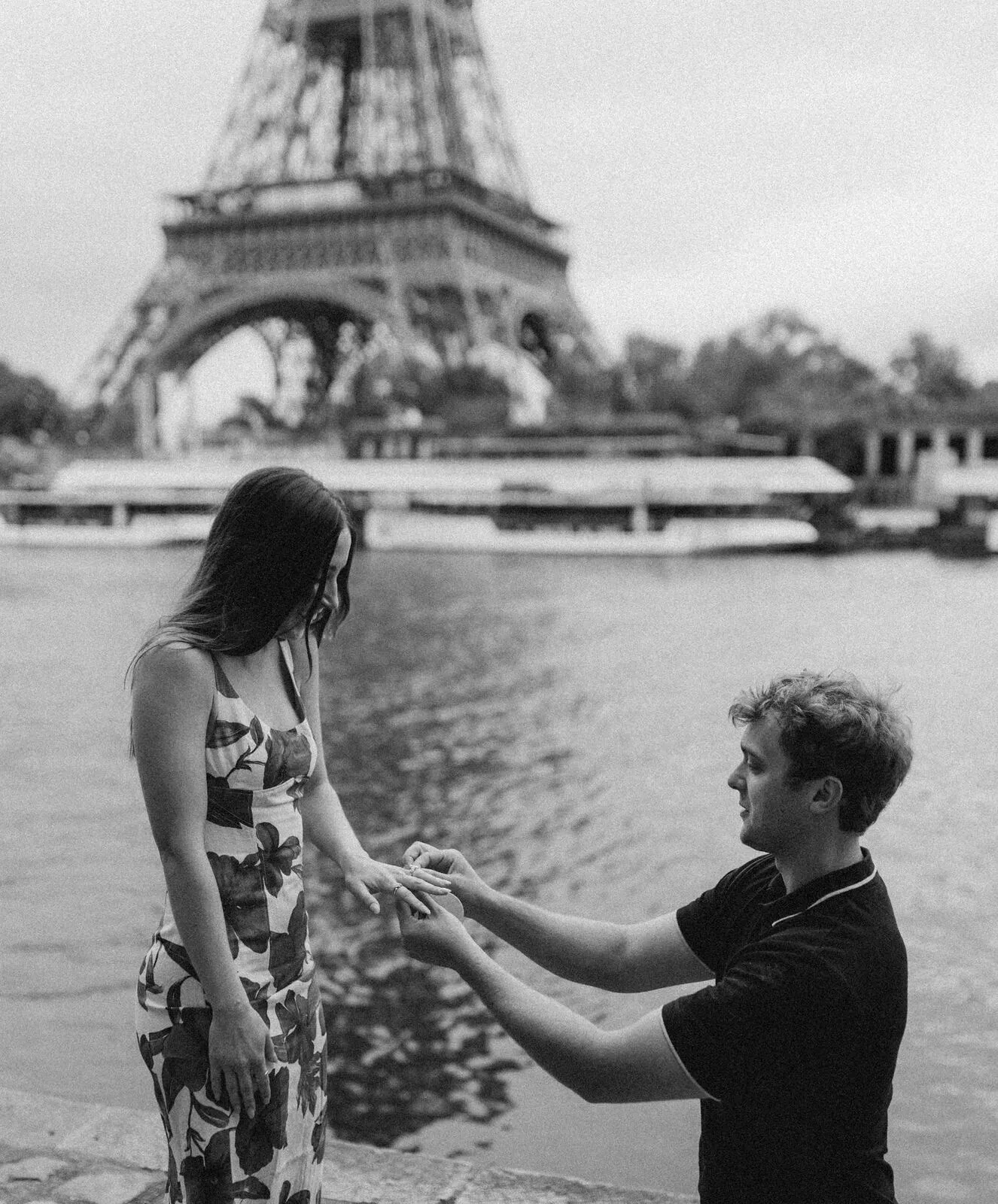
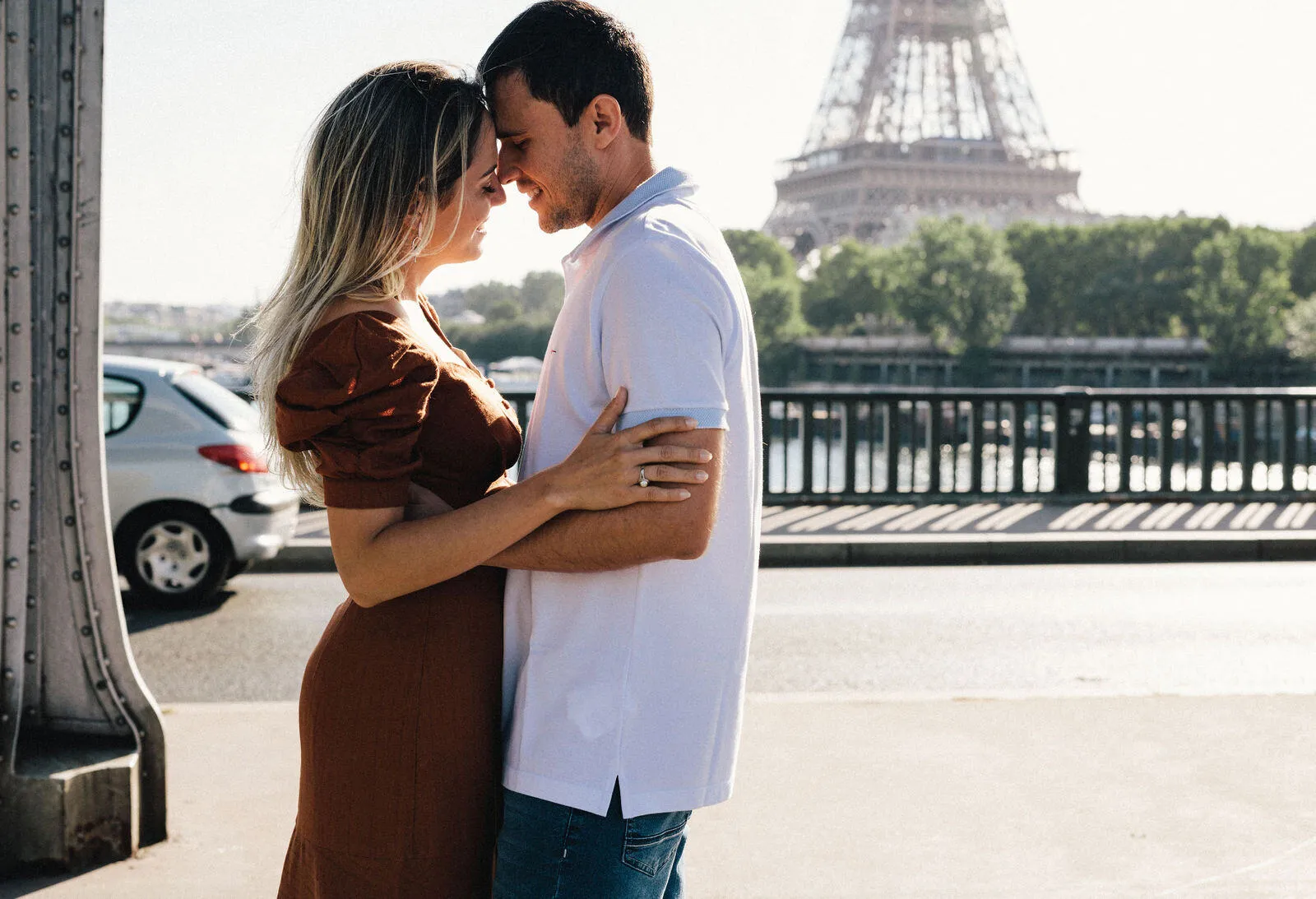
- Eiffel Tower views. Bir-Hakeim bridge, Avenue de Camoëns, Rue de l’Université, the Seine banks and the Champ de Mars side. Unbeatable backdrop, but you share it with everyone else who had the same idea; the Trocadéro esplanade is the busiest of all, even early. Our guide to an Eiffel Tower proposal without the crowds covers timing and quieter angles.
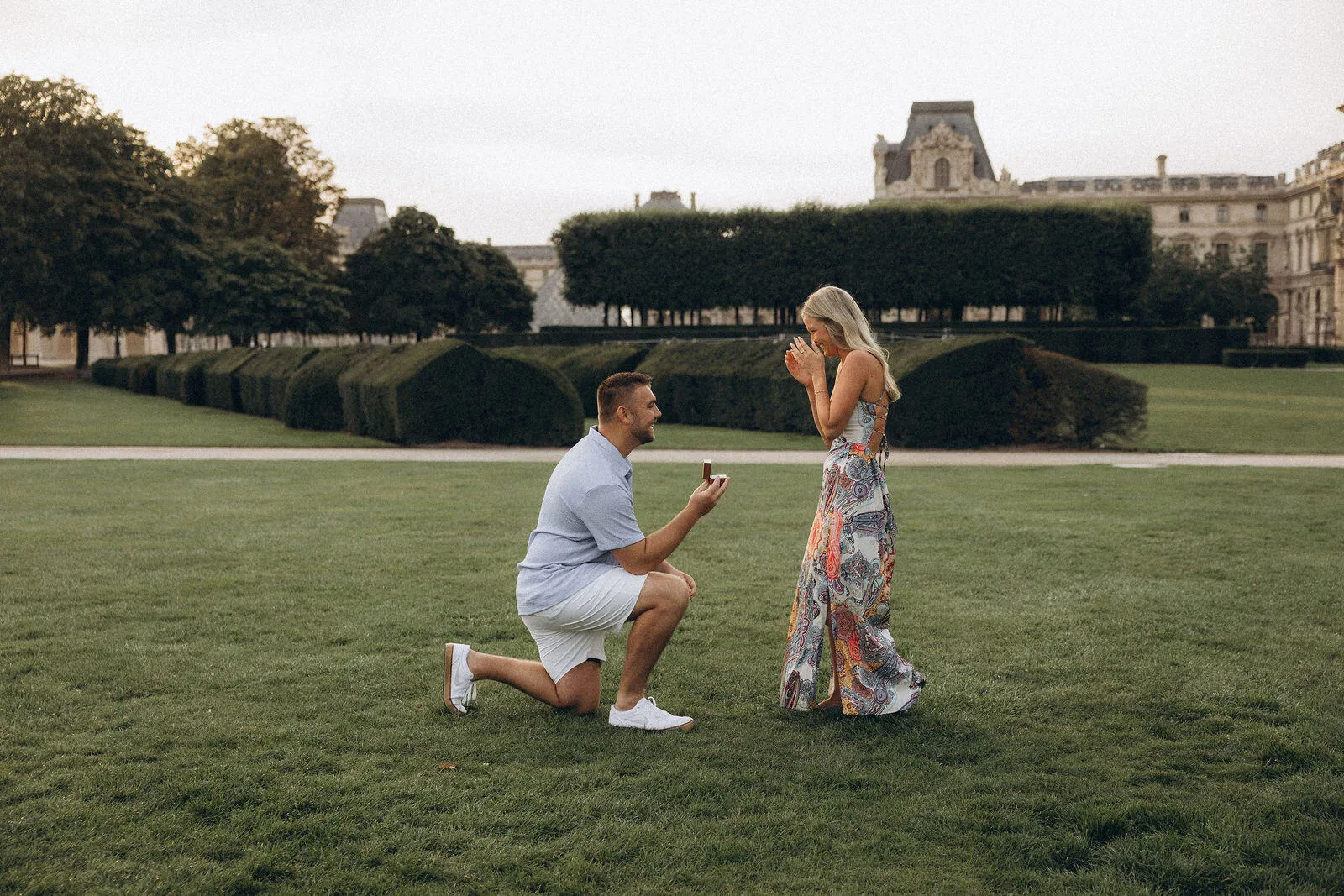
- Gardens, courtyards and bridges. Palais-Royal, the Tuileries, the Luxembourg Gardens, Pont Alexandre III, the quays of Île Saint-Louis. Romantic, softer light, and far easier to get a few minutes alone.
- Private places. A hotel balcony, a rented terrace, a private boat. You control the audience completely, but you need a reservation, and often a planner.
Our photographer-led list of the best places to propose in Paris compares 14 spots by crowd level, light and accessibility. As a rule of thumb, pick a place your partner would enjoy even without a ring in your pocket, and pick a backup within a short walk or taxi ride.
A word on rules and “rested” spots
The City of Paris starts from the principle that photography is free, but it requires authorization for organized film and photo shoots on public space, and it publishes a list of places “rested” (closed to shoots) until further notice. In October 2026 that list includes the whole Montmartre and Sacré-Cœur perimeter, the Champ de Mars, Place de la Concorde, Rue Crémieux, Avenue de Camoëns and the Île Saint-Louis; the Bir-Hakeim bridge is on the same list, with crews asked to contact the City’s film office first because of the number of shoots, and the Notre-Dame forecourt is rested every weekend.
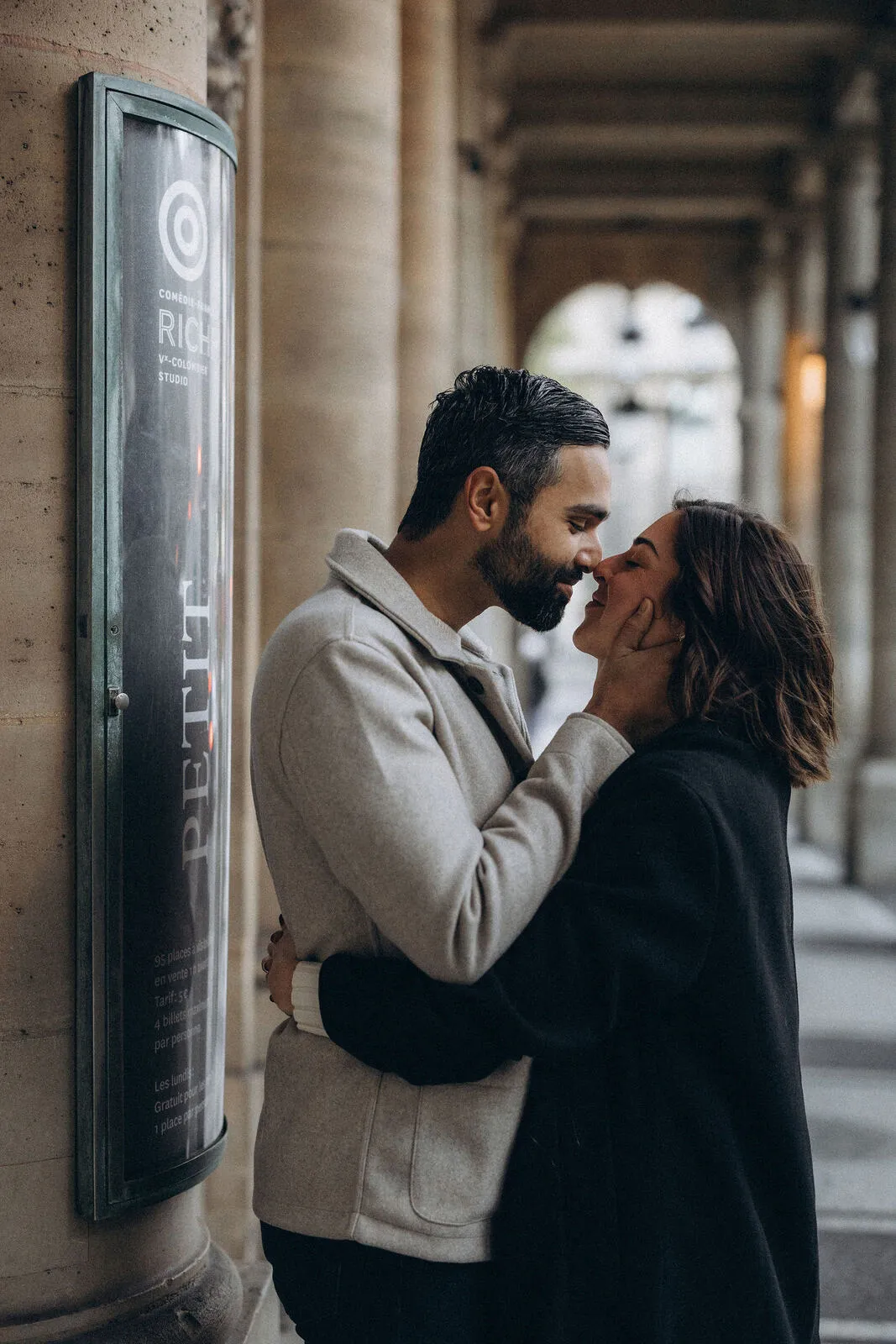
Those rules are written for productions. Whether a one-hour private session with a single photographer needs a declaration is a gray zone that no official page settles, and in practice these sessions happen every day. Some sites have their own managers and rules: the Luxembourg Gardens (run by the French Senate) require special authorization for professional photography, and the national monuments agency that manages the Palais-Royal publishes a flat rate of €150 excluding VAT for a two-hour non-commercial wedding or group photo session. A good local photographer knows which spots are tolerated and which managers expect a request, so ask them before you lock in a place.
Pick the time of day, and a plan B
The hour matters as much as the place. Here is what the light and the crowds look like across the year in Paris.
| Date | Sunrise | Sunset | What it means for a proposal |
|---|---|---|---|
| 15 January | 8:39 am | 5:22 pm | Late, gentle sunrise; a late-afternoon plan can run into blue hour and the first sparkle |
| 15 April | 7:01 am | 8:42 pm | Comfortable sunrise timing, long evenings |
| 15 June | 5:47 am | 9:56 pm | Very early sunrise; the first sparkle after dark is not before about 11 pm |
| 15 September | 7:27 am | 8:05 pm | Warm light at reasonable hours on both ends of the day |
| 15 December | 8:38 am | 4:55 pm | Short days; early-evening plans are easy |
Sunrise and the hour after it is the quietest window in central Paris. Many photographers like to start 30 to 45 minutes after sunrise, when the light is soft and the streets still feel empty. The trade-off is the alarm clock, and a cover story that explains it.
Daytime works best in gardens and courtyards, where trees and arcades soften harsh light. Expect more people everywhere.
Evening and night bring golden light, then the lit Eiffel Tower. The tower sparkles for five minutes on the hour from nightfall until it closes for the night (usually around midnight, 1 am in summer), so check the official calendar for your date. Your own photos of the sparkling tower are fine for personal use, including sharing with friends; using them commercially requires authorization from the tower’s operator. Evenings are also the busiest time at every Eiffel viewpoint.
Plan for rain, crowds and big events
Rain in Paris is spread through the year: on average there are 7 to 11 days with measurable rain every month, so a backup is not pessimism, it is planning. Covered options close to the classic spots include the arcades of the Palais-Royal and the arcades along Rue de Rivoli. Clear umbrellas photograph well, and a light drizzle often makes the streets emptier and the photos moodier. Our rain plan for a Paris proposal lists covered spots and how to decide on the morning.
Big events change the city too. Fashion Week, the Paris Marathon (a Sunday in early April), Bastille Day and the launch of the Champs-Élysées Christmas lights (mid to late November) bring road closures, security perimeters and crowds near the Champs-Élysées, Concorde, Trocadéro and the Champ de Mars. For many Paris proposal planners, Valentine’s Day is the busiest time of the year, which means more setups competing for the same views.
Decide who takes the photos
If you want photos of the moment itself, you need someone whose only job is to watch for it. A friend with a phone can work, but a professional knows where to stand, how to stay unnoticed and how to turn a three-second reaction into a full sequence.
There are two common approaches. Some photographers hide at a distance with a long lens. Others prefer to be in plain sight: either the session is presented as an ordinary couple photoshoot (the “photoshoot cover”), or the photographer plays a passer-by whom you ask to take a picture of you both. We explain both, with the messages to exchange and the signal to agree on, in how a secret proposal photoshoot works in Paris.
When you compare photographers, look for:
- real proposal sequences in their portfolio, not just posed couples;
- a language you are both comfortable in;
- clear terms: length, number of edited photos, delivery time, deposit, what happens if it rains;
- a written agreement on whether they may post your photos online.
You can browse portfolios and contact photographers directly in our free directory, filtering for couple photographers who speak English. There is no commission and no booking fee: you agree on the price with the photographer and pay them directly. For a proposal, contacting photographers six to ten weeks ahead leaves time to plan the scenario together (two to three months for Valentine’s Day).
Build a cover story that gets them there
The cover story has three jobs: get your partner to the right place at the right minute, dressed for photos, without raising suspicion. The best ones are boring.
- The couple photoshoot. You “booked a photographer as a trip souvenir”. It explains the early start, the nice outfits and the stranger with a camera.
- The sunrise walk. You want to see the tower without crowds before breakfast. It works well for early risers.
- The reservation. A breakfast or dinner booking near the spot gives you a reason to be there at a fixed time.
Avoid over-explaining, and do not change the plan at the last minute unless you have told the photographer. We collected more scripts, and the classic mistakes, in our proposal cover story ideas.
Get the ring to Paris safely
Treat the ring like your passport: it never goes in checked luggage. Keep it in your carry-on, in a small pouch or a slim box, and move it to a front pocket on the day (crowded viewpoints attract pickpockets, and a back pocket is the wrong place for anything you cannot replace). Check that your insurance covers jewelry while traveling, keep the receipt with you, and decide in advance where the ring sleeps at the hotel.
Airport screening, customs questions and travel insurance deserve their own checklist: see flying to Paris with an engagement ring.
What to do after the yes
The proposal lasts seconds; the half hour after it is where most of your favorite photos will come from. Plan for it:
- Portraits right away. Book enough time for portraits nearby after the moment itself. You will both be relaxed and happy, which photographs better than any pose.
- A reservation. A breakfast, a lunch or a glass of champagne booked nearby gives the morning a natural next step.
- The calls home. Decide in advance whether you will call family on the spot or later. Paris is usually six hours ahead of New York, so a sunrise yes lands in the middle of the night on the East Coast.
- The gallery. Delivery times vary by photographer, from a few days to a few weeks. Ask before you book if you want photos for an announcement on a specific date.
How to propose in Paris: a planning timeline
- Two to three months before: choose the format and the budget, shortlist spots, start comparing photographers or planners.
- Six to ten weeks before: book the photographer or planner, agree on the spot, the backup and the time.
- Two weeks before: settle outfits, send the photographer a recent photo of you both, finalize the cover story.
- The day before: check the weather, confirm the meeting point, share live locations with the photographer.
- On the day: arrive early, keep the ring in a front pocket, and let the photographer lead once your partner says yes.
FAQ
What is the best month to propose in Paris?
Spring (April to June) and early autumn (September and October) offer mild weather and soft light at reasonable hours. Winter has short days and misty mornings, which suit early proposals. Many Paris planners describe Valentine’s Day as their busiest time of the year, so book well ahead if you aim for it.
How much does it cost to propose in Paris?
A photo-only proposal usually costs about the same as a one-hour photo session, roughly €220 to €380 with an independent photographer at the time of writing (October 2026). Planner packages start at around €590 at one Paris agency, with average spends of €1,500 to €2,000 reported by Reuters. Travel, the ring and dinner come on top.
Do you need a permit to propose in Paris?
Asking the question itself involves no paperwork. The gray zone is around photography and decoration: organized shoots on public space need authorization, some sites (the Luxembourg Gardens, national monuments) have their own rules, and several places are closed to shoots. Ask your photographer or planner what applies to the spot you chose.
Is it better to propose at sunrise or at night?
Sunrise gives you quiet streets and soft light, which is ideal if your partner dislikes an audience. Night gives you the lit Eiffel Tower and its sparkle, but every viewpoint is busier. Many couples choose sunrise for the proposal and save the evening for dinner.
Can you propose at the Eiffel Tower itself?
You can propose in front of it, and you can propose at the summit as a regular visitor, but the top is often crowded and windy, and the operator handles professional photo sessions inside the monument through its own film team, so ask before bringing a hired photographer up. Most couples propose at a viewpoint with the tower behind them instead.