Can Americans get married in Paris? The legal answer, simply explained
Can Americans get married in Paris? The official French rules on residence, banns and paperwork, and the route most US couples take instead.
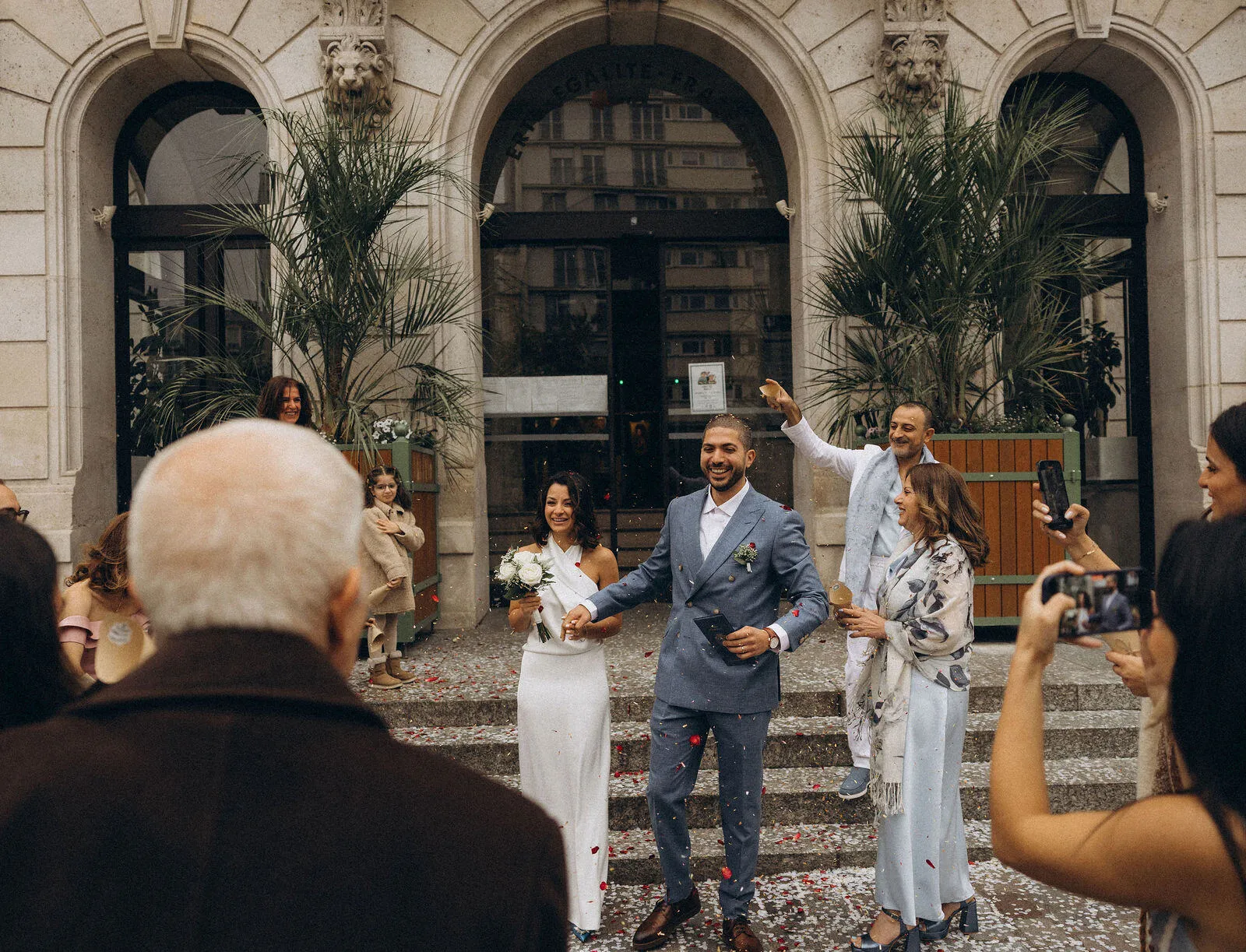
Can Americans get married in Paris? For most American couples, no: two US citizens visiting Paris cannot have a legally binding wedding there. French law only allows a civil marriage in a town where one partner has a lasting link (a home, at least one month of continuous residence when the banns are published, or a parent’s home), and two foreigners who do not live in France can only marry in France at their own country’s consulate. The usual solution is simple: marry legally at home, then celebrate in Paris with a symbolic ceremony, an elopement or a vow renewal. Below, we walk through the official rules, the few situations where an American can marry legally in Paris, and how to plan the version that works for almost everyone.
Can Americans get married in Paris? The short answer by situation
The rules depend less on your passport than on where you and your partner live. Here is how they apply to the most common situations for US couples, based on the French government’s official page on where a marriage can take place.
| Your situation | Legal wedding at a Paris town hall? | What couples usually do |
|---|---|---|
| Two Americans living in the US, visiting Paris | No | Legal wedding at home, symbolic ceremony or elopement in Paris |
| One of you has lived in Paris for at least a month when the banns are published | Possible | Civil wedding at the town hall, after the paperwork |
| One of you has a home in Paris (for example, you live there) | Possible | Civil wedding at the town hall |
| One of you has a father or mother whose home is in Paris | Possible | Civil wedding at the town hall of that parent’s district |
| You marry a French partner whose home or parent’s home is in Paris | Possible | Civil wedding at the town hall |
| You are already married and want to celebrate in Paris | No legal step needed | Vow renewal or anniversary celebration |
If you recognize yourself in the first line, skip ahead to the section on the route most couples take. If you are in one of the “possible” lines, read on: the rules are precise, and the town hall has the final word on your file.
What French law requires for a legal wedding
Only a civil ceremony counts
In France, a marriage becomes legal only when a French civil authority performs it, at the town hall (the mairie). The US Embassy in France puts it plainly: all marriages in France must be performed by a French civil authority, before any religious ceremony takes place, and a religious ceremony on its own does not constitute a legal marriage. A church blessing, a garden ceremony or vows on a bridge can be beautiful, but none of them marries you in the eyes of French law.
The “lasting link” rule
The official rule is that a marriage is celebrated in a town (a commune) with which at least one of the two partners has a lasting link. Service-public.fr, the French government’s information site, lists three ways to have that link:
- Domicile: one of you has your home in that town.
- Residence: one of you has lived there continuously for at least one month on the date the banns are published.
- A parent’s home: the town where the father or mother of one of you has their home.
Notice what the residence rule measures. It is not “a month before the wedding” but a month of continuous living in the town by the day the banns go up. That detail matters for the timeline below.
The banns: ten days of public notice
Before any civil wedding, the town hall publishes the banns, a public notice of the upcoming marriage. They stay posted for 10 days, and the wedding cannot be celebrated before the 10th day after publication. The official example: banns published on August 4, 2026 allow a wedding from August 14, 2026.
You may have read different fixed day counts on wedding blogs. Those numbers are shortcuts that add a residence period and the banns together, and they do not match each other. The legal rule is the one above: one month of continuous residence at the date of publication, then the banns period.
Why two American tourists cannot marry legally in Paris
For two partners who are both foreign and do not live in France, the official page is unambiguous: a marriage in France is possible only at the consulate of their country of origin (or in certain French overseas collectivities and New Caledonia). A town hall in Paris will not marry you.
For Americans, the consulate route does not open a door either. The US State Department says that US embassy and consulate staff cannot perform marriages abroad, so there is no American “consulate wedding” to book in Paris. In practice, this means that for a US couple on a trip, a legal wedding in Paris is not an option, however the trip is organized.
Two things follow from this:
- A long vacation is not the same as living in France. The residence rule is about living in the town, and the rule for two foreigners who do not live in France is a separate one. If you are thinking of relocating for a while to marry, ask the town hall before you make any plans.
- A ceremony in Paris has no legal effect in France. That is not a problem; it simply means your legal marriage happens elsewhere, on paper, and Paris is where you celebrate it.

When an American can marry legally in Paris
Some Americans do meet the conditions. The most common cases are an American who lives in Paris (for work or study, for example), an American marrying a French partner whose home or parent’s home is in Paris, and an American whose father or mother lives in Paris. If that is you, here is what the official sources say about the file.
The paperwork for US citizens
French town halls usually ask foreign partners for a certificat de coutume, a document showing they are free to marry under their own country’s law. According to service-public.fr, it is generally provided by the partner’s embassy or consulate. The United States is an exception: US authorities cannot issue one.
Instead, as the US Embassy explains, US citizens sign an “Attestation tenant lieu de certificat de coutumes et de célibat” (a statement in place of the certificate of custom and of single status). The Embassy says it does not need an Embassy notarization; if a town hall insists on a seal anyway, the Embassy charges $50 per seal. The Embassy also advises contacting the town hall for the exact list of documents, because each file is handled locally.
Other points from service-public.fr:
- A birth certificate issued abroad must be a full extract with parentage, no more than 6 months old.
- That age is counted from the day you file the marriage file at the town hall, not from the wedding day.
- The town hall’s registrar normally interviews the two of you together before the wedding (an interpreter can be requested if one of you does not speak French).
- Ask the town hall about translations and any other documents for your case before you travel with your papers.
Same-sex couples
The conditions for a civil marriage in France are the same for same-sex and different-sex couples. French law adds a special rule (Civil Code, article 171-9) for same-sex couples in which at least one partner is French and who live in a country that does not allow their marriage: they can marry in a French town they have a link with. It does not help two American partners, and same-sex marriage is legal in the US anyway. For planning ideas, see our guide to a same-sex elopement in Paris.
What about a PACS?
A PACS (pacte civil de solidarité) is a French civil partnership. The US Embassy notes that the United States does not recognize a PACS as a marriage, so it is not a substitute if your goal is to be legally married at home.
The route most US couples take: legal at home, celebration in Paris
Since a legal Paris wedding is out of reach for most visitors, the common plan has two parts.
- The legal part at home. Get your marriage license and sign the papers in your home state, with a small courthouse or city hall ceremony, before or after the trip. Rules and waiting periods vary by state and county, so check yours early.
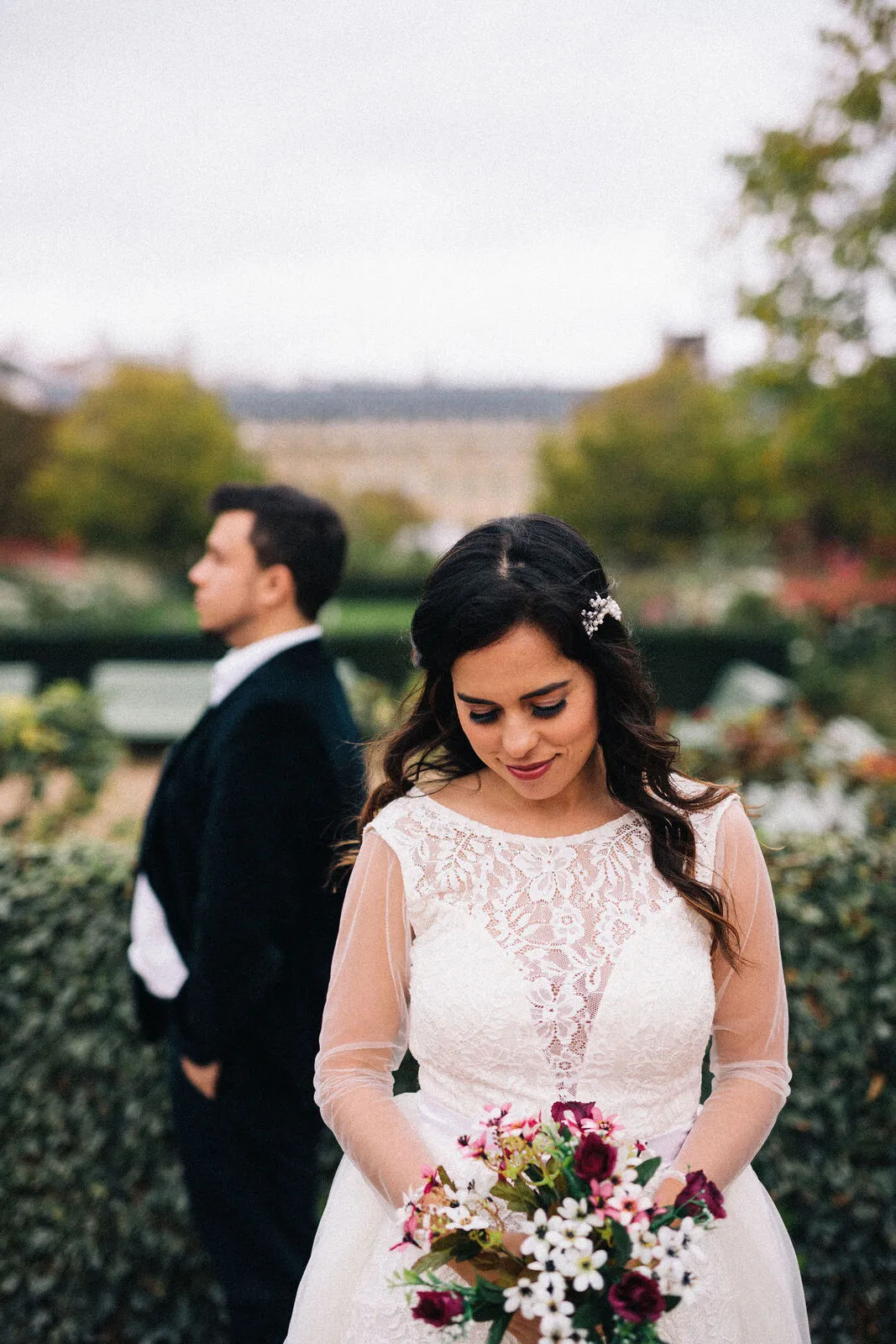
- The meaningful part in Paris. An elopement in Paris, a symbolic ceremony with an officiant or a friend, or just the two of you exchanging private vows on a bridge at sunrise, followed by portraits across the city.
Both orders work. Couples who marry at home first travel as newlyweds and often treat Paris as the “real” wedding day. Couples who go to Paris first sometimes keep the courthouse step for the week after, so the Paris vows feel like the moment they got married. Neither changes anything legally in France: what you do in Paris is symbolic, and that is exactly what gives you freedom.
| Symbolic ceremony | Elopement | Vow renewal | |
|---|---|---|---|
| Legal effect in France | None | None | None |
| Who is there | You, an officiant, a few guests | Usually just the two of you and a photographer | You, sometimes family |
| Who officiates | Anyone you choose | Optional | Optional |
| Photography time to plan for | 2 to 4 hours | 1.5 to 4 hours | 1 to 2 hours |
| Where | Private venue, garden, restaurant room, or a quiet public spot | Bridges, gardens, streets | Anywhere meaningful |
Budget depends mostly on the photographer, the officiant and how many people come. Our Paris elopement cost breakdown goes line by line.
A realistic planning timeline
For couples marrying at home and celebrating in Paris, the timeline is about your two dates, not French paperwork.
- 6 to 12 months before: pick the season and the Paris date, then the home date (before or after). Check your state’s marriage license rules and how long a license stays valid.
- 4 to 8 months before: book your Paris photographer and, if you want one, an officiant. Book earlier if you are aiming for a spring or early fall weekend.
- 2 to 4 months before: choose your spots with your photographer, plan outfits, and book hair and makeup if you want it.
- 1 month before: confirm meeting points, times and the rain plan. If a ceremony site charges a fee or needs permission, it should be settled by now.
- After the trip: if you married at home first, you are done. If the legal step comes after Paris, keep the license dates in your calendar.
If one of you qualifies for a legal French wedding, the timeline is different: count the month of continuous residence before the banns, the 10 days of banns, the town hall’s own appointment delays, and documents that must be under 6 months old when you file. Start with the town hall, not with vendors.
What a symbolic ceremony in Paris can and cannot do
A symbolic ceremony has no legal requirements of its own, which means you choose the words, the language, the officiant and the format. What it does not escape is the rules of the place where you hold it.
- Public spots are managed by different authorities. The City of Paris, the Louvre, the Senate (Luxembourg Gardens) and the Centre des monuments nationaux each have their own rules for organized photo shoots and events.
- The Palais-Royal is a clear example. Its manager, the Centre des monuments nationaux, publishes a flat rate for non-commercial wedding photos (the couple, one photographer and up to two companions) or group photos: €150 excluding VAT, €180 including VAT, for two hours, at the time of writing (October 2026).
- Private venues (a restaurant’s private room, a hotel terrace, a boat) avoid most of these questions, because the venue owner sets the rules.
Ask your photographer and officiant how they handle permissions at the spots you like. Experienced wedding photographers know which places welcome a small vow exchange and which ones require a request first. You can filter photographers who list weddings in our directory with the wedding specialty, and contact them directly, with no commission or booking fee.
Checklist before you book anything
- Read the official rule on service-public.fr and the US Embassy page, and decide which line of the table above is yours.
- If you are two US visitors: plan the legal wedding at home and choose its date.
- If one of you may qualify for a French civil wedding: contact the Paris town hall concerned first for the document list and timing.
- Choose the Paris format: elopement, symbolic ceremony with guests, or vow renewal.
- Book the photographer, then the officiant, then hair, makeup and flowers.
- Ask about permissions and fees for each ceremony spot.
- Keep a rain plan and a backup time slot.
This guide summarizes official public information as of October 2026; it is not legal advice. For your own case, the town hall and the US Embassy are the authorities to ask.
FAQ
Can Americans elope in Paris?
Yes, as a celebration. Two Americans can hold a symbolic elopement in Paris, with or without an officiant, but it will not be a legal marriage in France. Most couples sign their marriage license at home before or after the trip.
How long do you need to live in France to get married there?
The official rule is that one partner must have lived continuously for at least one month in the town on the date the banns are published, unless one of you has your home there or a parent’s home is there. The banns then stay posted for 10 days, and the wedding cannot take place before the 10th day after publication. Two foreigners who do not live in France can marry in France only at their own country’s consulate.
Is a religious wedding in Paris legally valid?
Not on its own. The US Embassy in France states that all marriages in France must be performed by a French civil authority before any religious ceremony, and that a religious ceremony does not constitute a legal marriage.
Can we get married in front of the Eiffel Tower?
Legally, no: a civil wedding in France is celebrated by the town’s registrar at the town hall (or, if the mayor decides, in another municipal building), never at a landmark. Symbolically, yes: many couples exchange vows or have portraits taken with the tower in view, often at sunrise when the viewpoints are quiet. Check each spot’s rules with your photographer before planning a ceremony there.
Is a symbolic ceremony in Paris recognized in the US?
No, because it is not a marriage in the first place: a symbolic ceremony has no legal effect in France, so there is nothing for the US to recognize. The marriage that counts legally is the one you register at home, which is why couples plan the two dates together.