Avenue de Camoëns: the Eiffel Tower view and how to shoot it
Avenue de Camoëns and its Eiffel Tower view: where it is, how to get there from Passy or Trocadéro, the best time for light and crowds, and etiquette.
Avenue de Camoëns is a short residential avenue in the 16th arrondissement of Paris, a five-minute walk from Trocadéro, that ends in a stone balustrade and a double staircase with the Eiffel Tower rising between the buildings. Type “Avenue de Camoëns, 75116 Paris” into your map app, get off the metro at Passy (line 6) or Trocadéro (lines 6 and 9), and walk to the end of the avenue where it overlooks Boulevard Delessert. Below, we cover exactly where to stand, how to get there, the best time for light and crowds, how to photograph a street where people live without bothering them, and why the City has closed it to organized shoots.
Where exactly is Avenue de Camoëns?
The avenue is tiny: about 115 meters long, running between Rue Benjamin-Franklin (the upper end, level with the Trocadéro neighborhood) and Boulevard Delessert (the lower end, about ten meters below). Because of the staircase at the bottom, it is a dead end for cars, which is a big part of its calm.
| Practical detail | What to know |
|---|---|
| Address for your map | Avenue de Camoëns, 75116 Paris (16th arrondissement) |
| The viewpoint | The balustrade at the lower end, above Boulevard Delessert |
| Nearest metro | Passy, line 6 (about 250 m); Trocadéro, lines 6 and 9 (about 400 m), both approximate |
| Distance to the tower | About 550 m in a straight line to the nearest part of the tower, across the Seine (approximate) |
| Steps | A double staircase at the lower end; the upper end is step-free from Rue Benjamin-Franklin |
| Cost | Free, public street |
The avenue is named after Luís de Camões, Portugal’s great Renaissance poet. At the foot of the staircase stands a monument to him in pink marble, by the sculptor Clara Menerès, installed in 1987. Several of its buildings went up in the 1900s and 1910s, and the one at No. 1 appears in François Truffaut’s film Le Dernier Métro (1980).
How to get there
From Passy (line 6). The station is a short walk from Boulevard Delessert, right by Bir-Hakeim bridge. Walk along Boulevard Delessert to the Camões monument, then climb the staircase: you arrive at the viewpoint from below, with the tower behind you. Count about five minutes, including the stairs.
From Trocadéro (lines 6 and 9). From Place du Trocadéro, walk down Rue Benjamin-Franklin and turn into Avenue de Camoëns. You walk down the avenue toward the tower, which appears little by little between the buildings. This is the step-free way in. Count about five to seven minutes.
From the Eiffel Tower. Cross the Pont d’Iéna to the Trocadéro gardens, then go up to Rue Benjamin-Franklin, or cross Bir-Hakeim bridge and walk up from Passy. Either way, about 15 to 20 minutes on foot.
By taxi. Ask for the Rue Benjamin-Franklin end. Because the avenue is a dead end, cars can enter from the top but cannot cross to Boulevard Delessert.
What the Eiffel Tower view from Avenue de Camoëns looks like
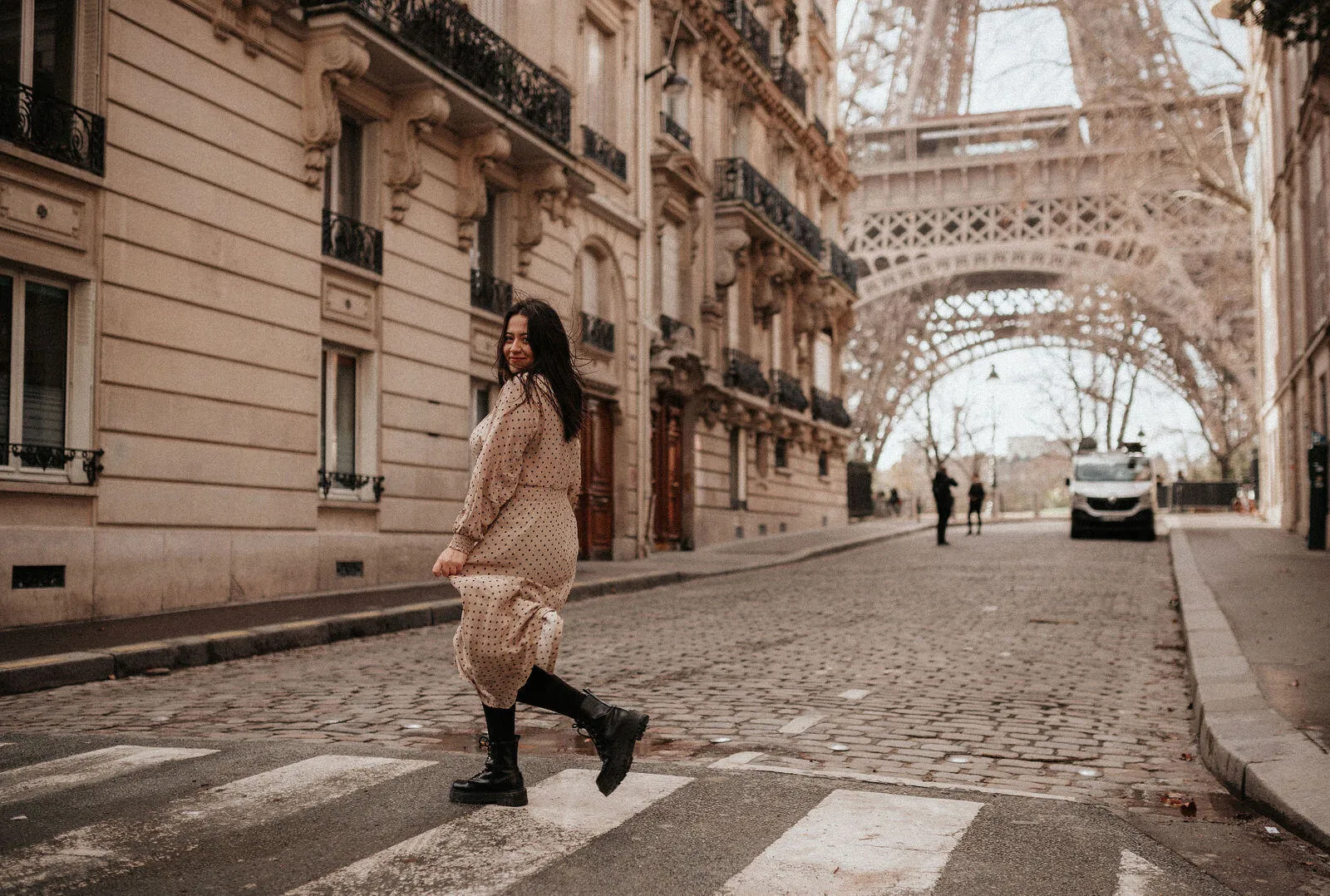
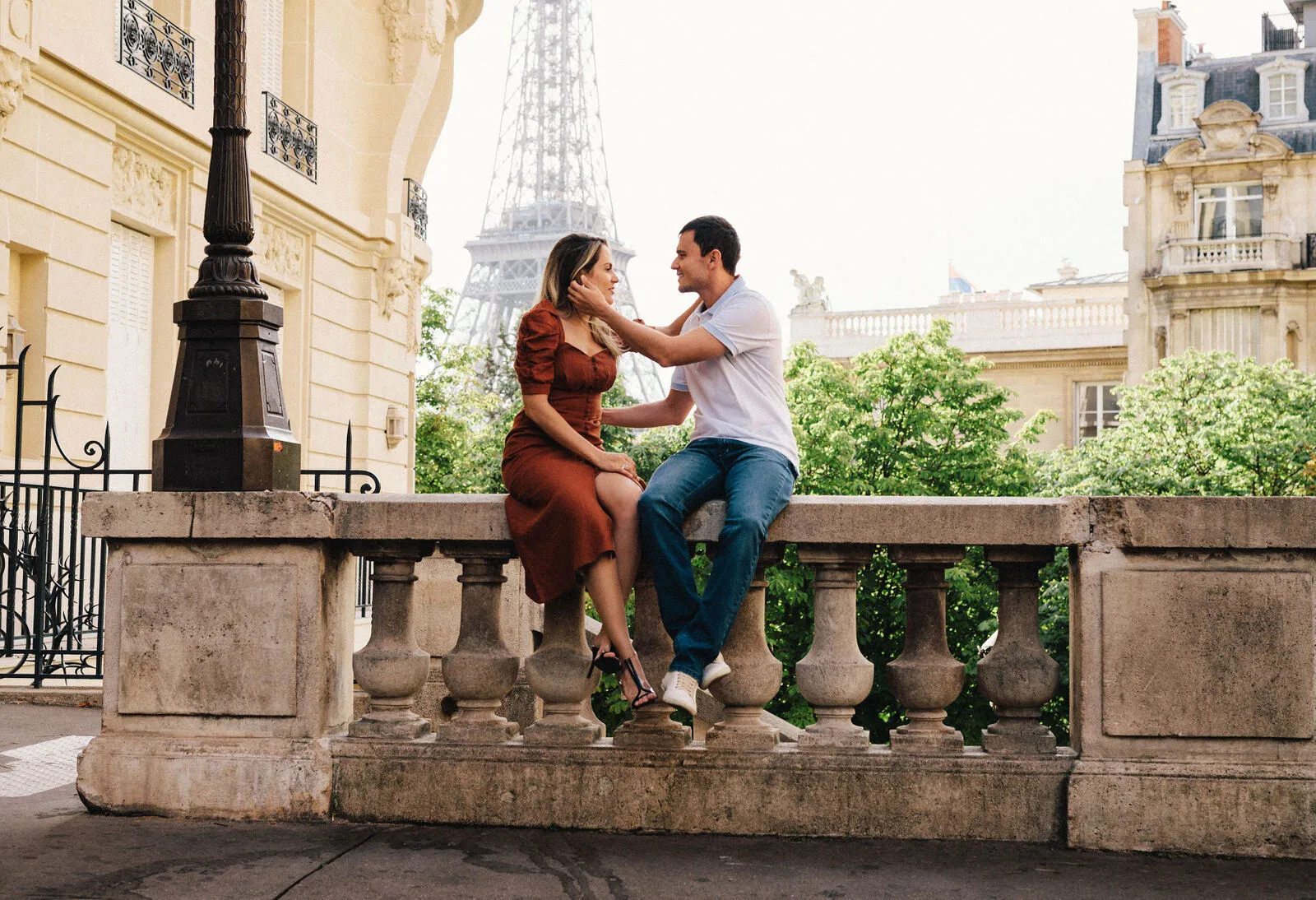
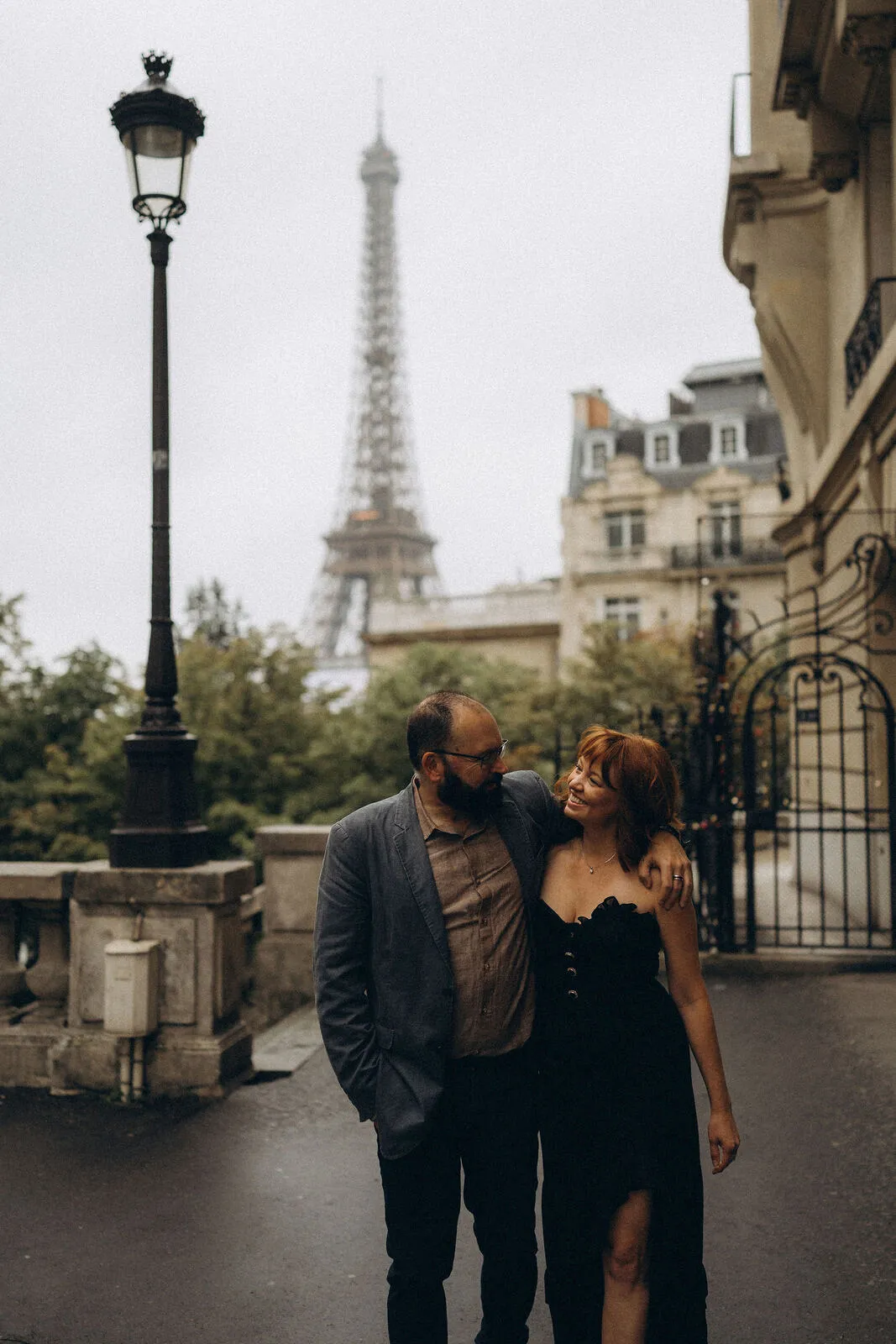
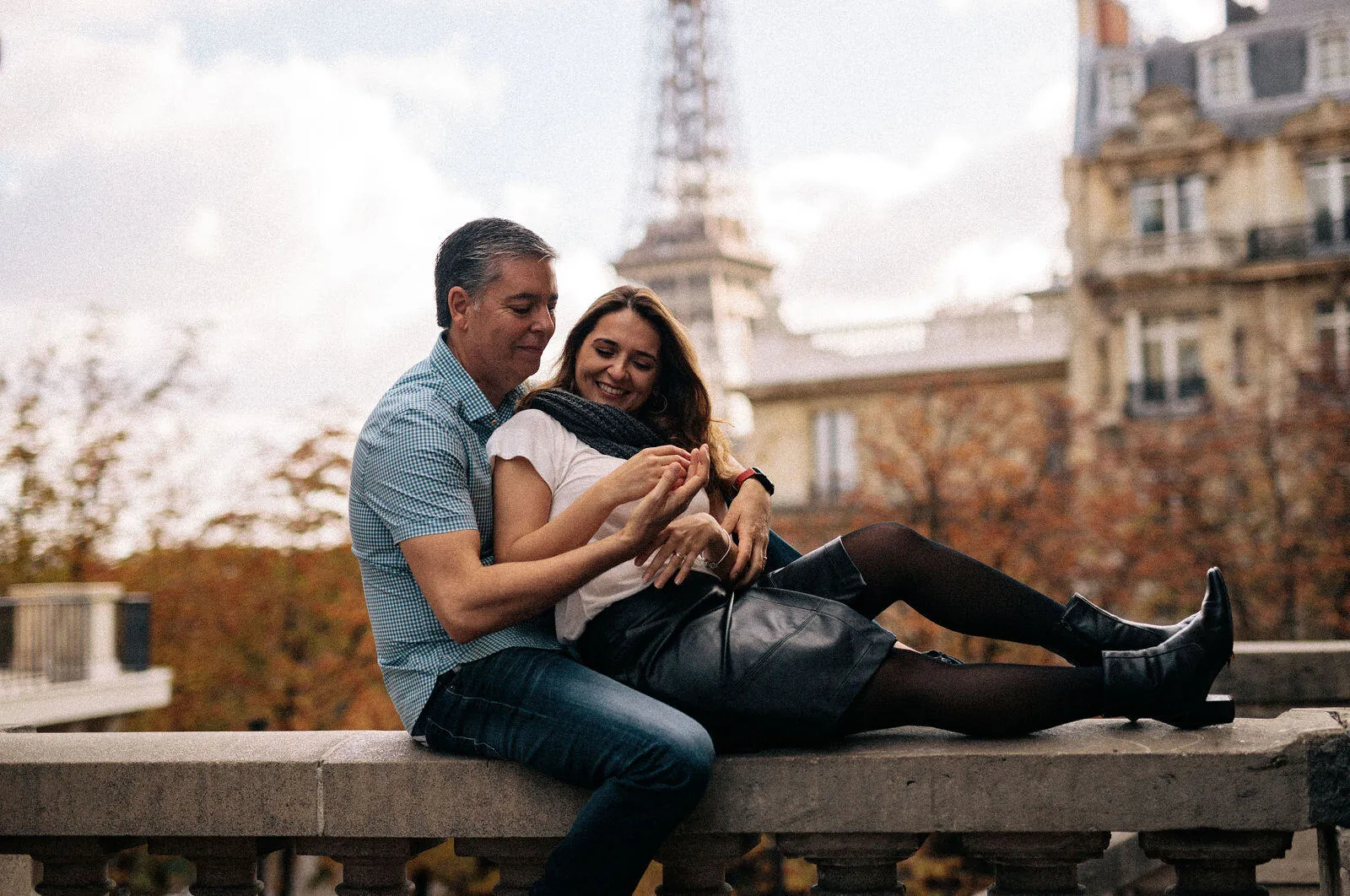
The magic of Avenue de Camoëns is that the tower is framed, not floating. Standing at the balustrade, you see it rising between cream-colored stone buildings, above the treetops of Boulevard Delessert, with old lamp posts on the balustrade itself. It looks like the view from a private Parisian balcony, which is exactly why couples love it.
There are three classic frames:
- At the balustrade, tower behind you. The photographer stands a few meters up the avenue, toward Rue Benjamin-Franklin, and zooms in slightly so the tower looks big behind you. This is the signature shot.
- Walking down the avenue. From near the top of the avenue, the tower sits at the end of the street. Walking toward it, hand in hand, makes a natural, unposed picture.
- On the staircase. The double flight of steps adds curves and depth. Sitting on a step or walking down gives you a softer, more intimate frame, with the tower above.
Best time to go: light and crowds
From the balustrade you face roughly east, slightly south, toward the tower. That matters for light (the sun directions below are our own approximate calculation, so allow a few weeks either way):
| Time | Light | Crowds |
|---|---|---|
| Sunrise to about 1 hour after | From about October to February the sun rises roughly behind or to the right of the tower: glowing sky, soft backlight, lovely silhouettes. In summer the sun comes from the left. | Very quiet; the best moment for an unhurried session |
| Mid-morning to mid-afternoon | Higher, harder light; the tower is well lit but faces can be contrasty | Residents, deliveries and a steady trickle of visitors |
| Late afternoon to sunset | Sun behind you: warm light on the tower and on your faces | The busiest time; in spring and summer you may wait your turn |
| After dark | The illuminated tower between the buildings | Variable; quieter after the sunset rush |
Travel guides still describe Avenue de Camoëns as far quieter than Trocadéro, and that is true compared to the esplanade. But it is no longer a secret: at sunset on a fine spring evening, other couples and photographers will be there. If you want it to yourselves, come early. Since the street is closed to organized shoots (see below), plan it as a short stop within a longer route, not a whole session.
A note on night photos: your own pictures of the illuminated tower are fine for personal use. Commercial use of the lighting needs the authorization of the tower’s operator, so creators and brands should plan a daytime shot or ask first.
Etiquette: this is a street where people live
Avenue de Camoëns is not a viewpoint built for visitors; it is a quiet residential street, and a school has an entrance on it. The view stays welcoming because people treat it with respect.
- Keep voices low, especially early in the morning. Windows open onto the avenue.
- Never block doorways, garage entrances or the staircase. Step aside for residents, parents and anyone carrying shopping or pushing a stroller.
- Avoid the start and end of the school day on weekdays, when families are coming and going.
- Don’t photograph residents or their windows, and don’t sit on parked cars or scooters.
- Leave no trace: no confetti, no rose petals, no balloons left behind.
- Keep the session light. One photographer and a camera fit the street; lighting stands, crews and big props do not.
Do you need a permit to shoot there?
Avenue de Camoëns is a City of Paris street with a special status. On its list of streets “rested” from filming, updated on 16 October 2026, the City’s film office says that no shoot will take place on Avenue de Camoëns until further notice. That list is written for film and photo productions: a crew, a commercial shoot or lighting will not be authorized here for now.
Your own pictures need nothing: the City’s starting principle is that you are free to take photos in public space. A small private session with one photographer is a gray zone everywhere in Paris, and here the City’s decision is a clear signal to keep things minimal. We would not build a session around this street while the rest applies: treat it as a short stop for a few discreet frames, or for your own phone photos, and ask your photographer how they handle it.
Combining Avenue de Camoëns with nearby spots
Camoëns sits in the middle of the best Right Bank viewpoints, which makes it easy to build a short route:
- Trocadéro first, at sunrise, for the full symmetrical view, then down Rue Benjamin-Franklin to Camoëns as the esplanade fills up. Our Trocadéro photoshoot guide gives arrival times by season.
- Down the staircase to Passy and onto Bir-Hakeim bridge, a few minutes away, for its iron colonnade. See the Bir-Hakeim spot page for the basics.
- Across the river, Rue de l’Université offers the other famous “street view” of the tower. Our Rue de l’Université guide explains how to shoot it safely.
For the full picture of every viewpoint, with the best hour for each, read our guide to the best Eiffel Tower photo spots. If you want a photographer who knows this corner of the 16th, you can search Paris photographers by spot in our directory and contact them directly.
FAQ
What is the address of Avenue de Camoëns?
Avenue de Camoëns, 75116 Paris, in the 16th arrondissement. The viewpoint is at the lower end of the avenue, where a balustrade and a double staircase overlook Boulevard Delessert. The nearest metro stations are Passy (line 6) and Trocadéro (lines 6 and 9).
How far is Avenue de Camoëns from Trocadéro?
About 400 meters, or five to seven minutes on foot via Rue Benjamin-Franklin. That is why many photographers start at Trocadéro at sunrise and move to Camoëns as the esplanade fills up.
When is the best time to photograph the Eiffel Tower from Avenue de Camoëns?
Early morning for calm, and late afternoon for warm light on the tower. In autumn and winter the sun rises roughly behind or near the tower (by our approximate calculation), which gives a glowing sky and soft silhouettes. Sunset is the busiest time.
Is Avenue de Camoëns crowded?
Much less than Trocadéro, but it is well known among photographers. Early mornings are very quiet; spring and summer sunsets can mean a short wait for your turn at the balustrade.
Can you do a photoshoot on Avenue de Camoëns?
Personal photos are free. The City has closed the avenue to organized film and photo shoots until further notice (list updated 16 October 2026), so plan a short, discreet stop with one photographer, or your own photos, rather than a full session. Whatever you do, respect the residents: low voices, clear doorways, nothing left behind.