The best time of year for a Paris photoshoot, month by month
The best months for a Paris photoshoot, with sunrise and sunset, weather, light and events for every month, plus the right season for each occasion.
The best time of year for a Paris photoshoot is late April to June or September to early October: mild weather, green or golden gardens, and sunrise and sunset times you can actually live with. But the month matters less than the hour, because a session booked at sunrise in January can look better (and feel calmer) than a midday shoot in May. Below you will find a month-by-month table with sun times, weather and events, a season-by-season breakdown, and our recommendation for each kind of shoot.
The short answer: which month to choose
If you can pick your dates freely, start from what matters most to you. Every month works for photos in Paris; each one simply asks for a different plan.
| Your priority | Best months | Why |
|---|---|---|
| Soft weather and green trees | Late April, May, June, September | Highs of 62 to 74 °F (16.6 to 23.4 °C), long days, gardens in full leaf |
| Fewest rainy days | July, September | 7.4 and 7.5 days with rain on average, the lowest of the year |
| Sunrise without a 5 am alarm | October to February | Sunrise between about 7:30 and 8:45 am |
| Sunset, blue hour and the sparkling Eiffel Tower in one session | November to January | Sunset between about 4:55 and 5:45 pm, first sparkle as early as about 6 pm |
| Autumn colors | October and early November | Golden leaves, low warm light, clocks go back on the last Sunday of October |
| Festive lights | Late November to early January | Christmas lights on the Champs-Élysées and around the city |
Our own pick, for a first trip with no constraint: mid-May or mid-September, with a session in the first hour after sunrise. You get pleasant temperatures, long golden light and quiet streets before the city wakes up.
Paris month by month: light, weather and what to expect
The sun times below are for the 1st of each month in central Paris (local time, daylight saving time included), from our research based on a standard solar calculation and cross-checked with timeanddate.com; they are accurate to about two minutes and barely move from one year to the next. Weather figures are the 1991 to 2020 Météo-France normals for Paris-Montsouris.
| Month | Sunrise / sunset (1st) | Avg high | Days with rain | Sunshine | What it means for photos |
|---|---|---|---|---|---|
| January | 8:45 am / 5:05 pm | 46 °F (7.6 °C) | 9.9 | 59 h | Shortest light, quietest landmarks, late sunrise |
| February | 8:22 am / 5:48 pm | 48 °F (8.8 °C) | 9.1 | 84 h | Still easy sunrises; Valentine’s week is busy for proposals |
| March | 7:34 am / 6:34 pm | 55 °F (12.8 °C) | 9.5 | 135 h | First blossoms late in the month, Fashion Week early in the month |
| April | 7:30 am / 8:21 pm | 62 °F (16.6 °C) | 8.6 | 177 h | Blossoms, fresh green trees, clocks have moved forward |
| May | 6:31 am / 9:06 pm | 68 °F (20.2 °C) | 9.2 | 201 h | Lush gardens, long evenings, wettest month by volume |
| June | 5:52 am / 9:46 pm | 74 °F (23.4 °C) | 8.3 | 204 h | Longest days: sunrise before 6 am, sunset near 10 pm |
| July | 5:52 am / 9:58 pm | 78 °F (25.7 °C) | 7.4 | 222 h | Sunniest month, heat at midday, Bastille Day |
| August | 6:24 am / 9:30 pm | 78 °F (25.6 °C) | 8.1 | 215 h | Warm, bright, best shot early or late |
| September | 7:07 am / 8:34 pm | 71 °F (21.5 °C) | 7.5 | 175 h | Few rainy days, warm light, a favorite for couples |
| October | 7:50 am / 7:31 pm | 62 °F (16.5 °C) | 9.5 | 119 h | Golden leaves, pink-lit Eiffel Tower, easy sunrise |
| November | 7:38 am / 5:31 pm | 52 °F (11.1 °C) | 10.4 | 70 h | Early sunsets, misty mornings, Christmas lights arrive |
| December | 8:23 am / 4:57 pm | 46 °F (8.0 °C) | 11.4 | 57 h | Festive lights, most rainy days, sparkle in the early evening |
Two details explain why the same month can feel so different in photos. First, Paris days stretch from about 8 hours 17 minutes in mid-December to about 16 hours in late June, so a “sunrise shoot” means meeting between about 5:30 and 6:30 am in June and between about 8:30 and 9:30 am in December, depending on whether you start at sunrise or a little after. Second, rain is spread evenly through the year: every month has between 7 and 11 days with at least 1 mm of rain, so no season is truly dry and none is a washout. For the full twice-a-month table with golden hour start and end times, see our golden hour planner for Paris.
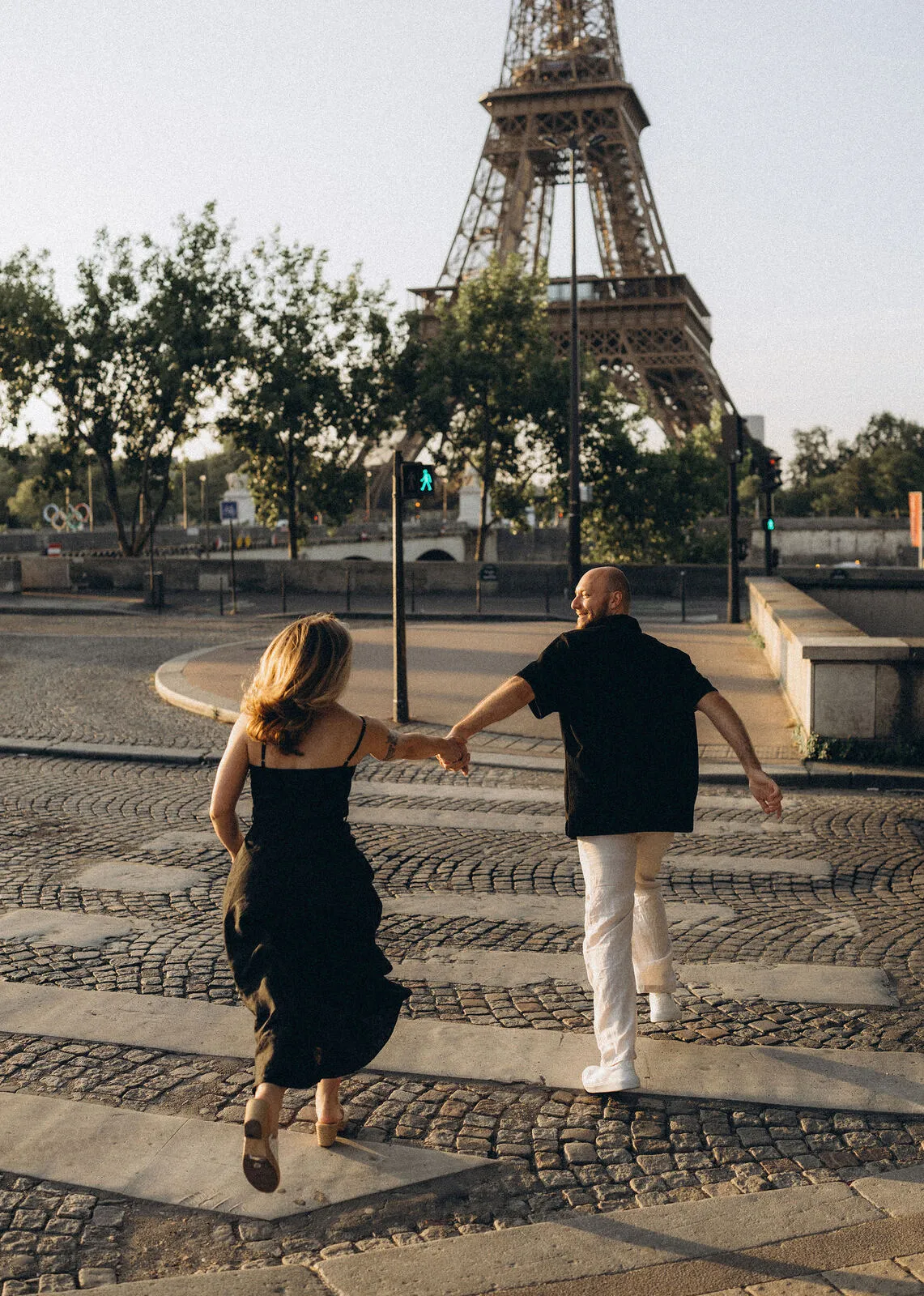
Season by season: what each one looks like in photos
Each season changes three things at once: the time of your session, what you wear, and what is in the background.
Spring (March to May): blossoms, fresh green and changeable skies
Spring is the season most people picture when they think of Paris photos, and for good reason. Trees leaf out through April, the gardens are neatly planted, and sunsets move past 8 pm once the clocks go forward on the last Sunday of March (28 March in 2027).
- March is a gamble on weather (highs around 55 °F, 12.8 °C) but often rewards you with clear, crisp mornings. Cherry trees usually start blooming in the last days of the month.
- April brings blossoms and that bright, fresh green. Sunrise jumps back to about 7:30 am after the time change, then moves earlier through the month.
- May is lush and warm (about 68 °F, 20.2 °C), with sunset after 9 pm. It is also the wettest month by volume (about 69 mm), although rain often comes as showers rather than whole gray days.
Spring is popular, so book your photographer and your sunrise slot early. Our spring photoshoot guide covers blooms, outfits and the best gardens in detail.
Summer (June to August): long days, early starts and heat
Summer gives you the most light and the most sun: July averages 222 hours of sunshine, against 57 in December. The trade-off is timing. Sunrise is around 5:47 am in mid-June, and the evening golden light starts around 9 pm, so the flattering hours are very early or very late.
- Sunrise sessions are the summer secret: cool air, quiet bridges, soft light. Expect to meet your photographer between about 5:30 and 6:30 am in June and early July.
- Sunset sessions run late. Sunset is close to 10 pm in late June and early July, and dusk only ends around 10:40 pm, so the first Eiffel Tower sparkle after dark is not before about 11 pm.
- Midday is harsh and hot, with average highs of 78 °F (25.7 °C) in July and August. If you can only shoot then, choose shaded streets, covered arcades or tree-lined gardens.
Bastille Day (14 July) brings a military parade on the Champs-Élysées in the morning and fireworks from the Eiffel Tower in the evening; the Champ de Mars fills up and its gates close when it is full. In 2026 the fireworks were exceptionally moved to 13 July, so check the arrangements for your year.
Autumn (September to November): golden light and calmer streets
Early autumn is the other sweet spot. September combines warm days (about 71 °F, 21.5 °C) with one of the lowest counts of rainy days (7.5), and sunset moves from about 8:30 pm to 7:30 pm across the month, which makes evening sessions easy to fit before dinner.
October is cooler (about 62 °F, 16.5 °C) and its leaves start to turn, usually peaking from late October into November. Every October the Eiffel Tower is also lit in pink for breast cancer awareness. Sunrise sits around 8 am, so a sunrise shoot no longer means a brutal alarm. Clocks go back on the last Sunday of October (25 October in 2026, 31 October in 2027), which suddenly pulls sunset back by an hour, to around 5:30 pm on 1 November.
November is gray more often (70 hours of sunshine), but it brings misty mornings, wet cobblestones that reflect the light, and the first Christmas lights. For outfit ideas and the best autumn spots, read our fall photoshoot guide.
Winter (December to February): quiet landmarks and early evening sparkle
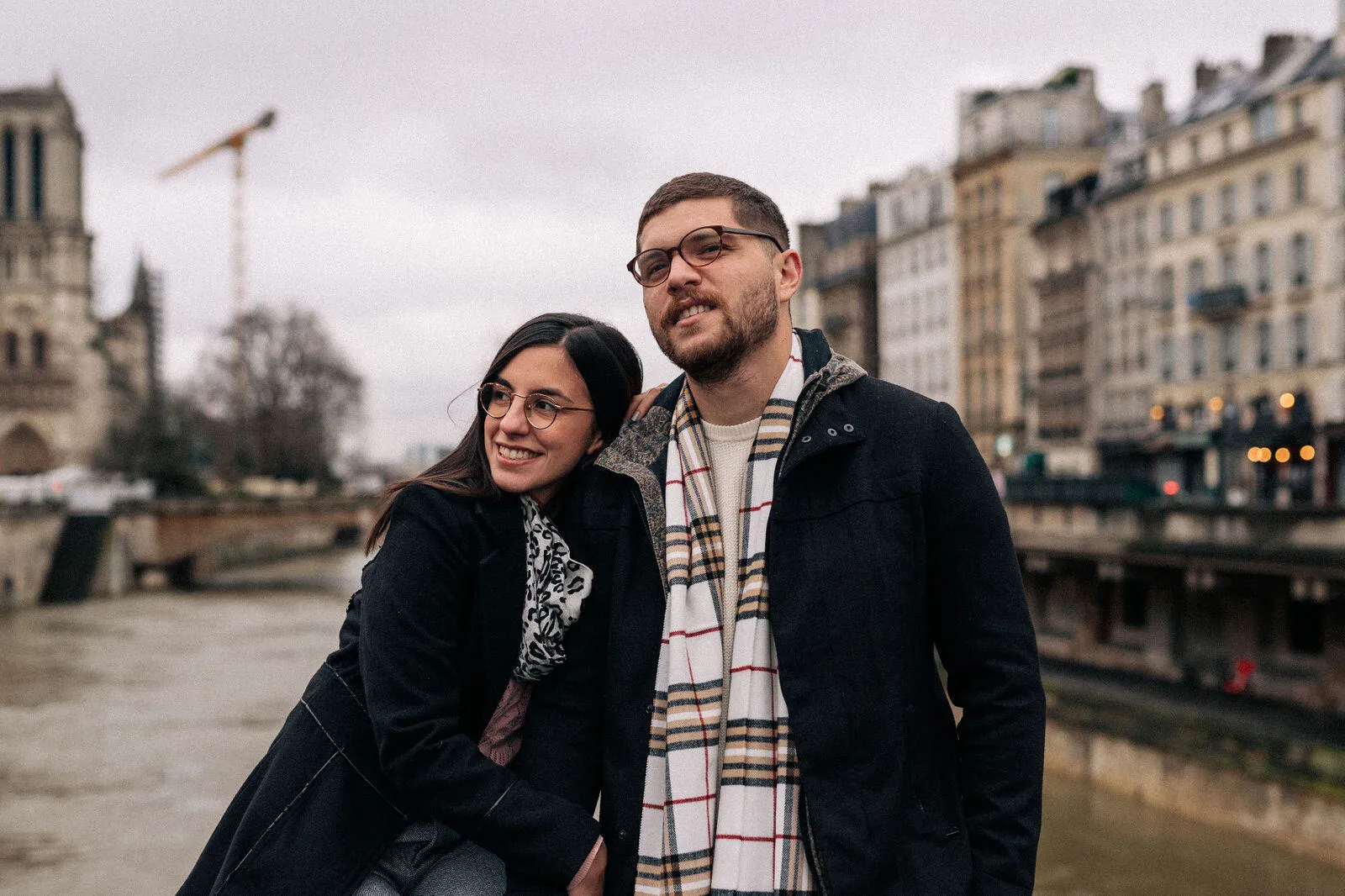
Winter is underrated for photos. Days are short (about 8 hours 17 minutes in mid-December) and cold (highs around 46 °F, 8 °C), but the sun stays low all day, so the light is soft for hours rather than minutes. Sunrise is between about 8 and 8:45 am, which makes a sunrise session at the Trocadéro realistic even after a late dinner.
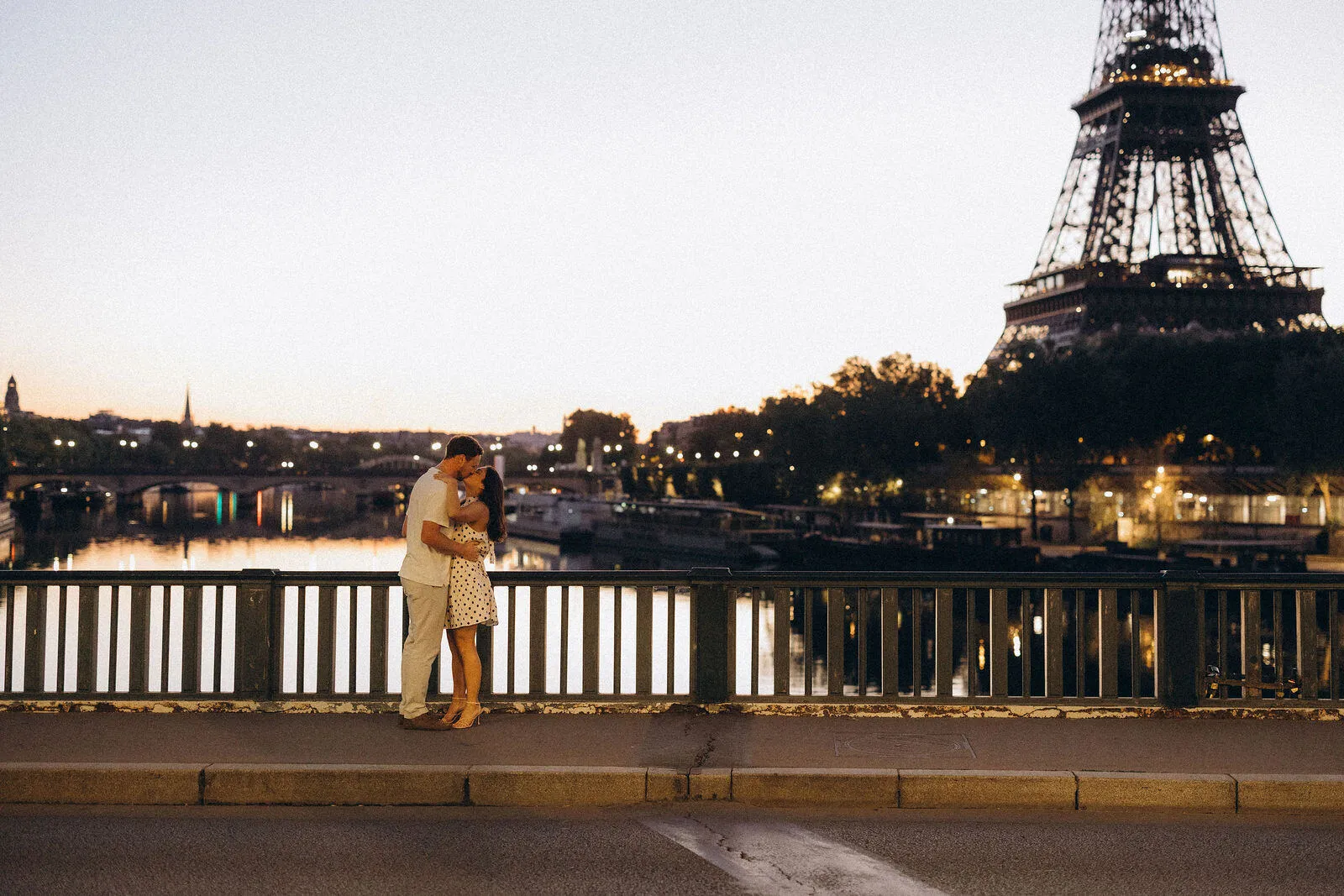
The real winter advantage is the evening. With sunset around 5 pm in December and early January, a session that starts around 4 pm can cover golden light, blue hour and the first Eiffel Tower sparkle (around 6 pm) in about two hours. That is impossible in June.
Snow is never something you can count on in Paris, so do not plan a session around it. December has the most rainy days of the year (11.4), so keep a covered backup spot in mind. Our guide to the low season in Paris explains how to make the most of quieter months, from rates to crowd-free landmarks.
Events that change crowds and access
Big events bring road closures, security perimeters and crowds near the Champs-Élysées, Concorde, Trocadéro and Champ de Mars. None of them ruins a shoot, but your photographer should plan around them. Here are the usual patterns, with the next dates only where the organizers had announced them at the time of writing (October 2026):
| Event | When it usually happens | Next known dates |
|---|---|---|
| Paris Fashion Week (menswear, couture, womenswear) | Mid or late January, early March, late June, early July, late September to early October | Men 19 to 24 Jan 2027; Couture 25 to 28 Jan 2027; Women 1 to 9 Mar 2027; Men 22 to 27 Jun 2027; Couture 5 to 8 Jul 2027; Women 27 Sep to 5 Oct 2027 |
| Paris Marathon | A Sunday in early or mid April | Sunday 4 April 2027, as announced by the organizers (half marathon on 7 March 2027) |
| Roland-Garros | Late May to early June | 17 May to 6 June 2027 (qualifying included) |
| Bastille Day | 14 July | Parade in the morning, fireworks from the Eiffel Tower at night |
| Nuit Blanche (all-night art event) | Historically early October | The 2026 edition took place on 6 June 2026: check each year |
| Champs-Élysées Christmas lights | Mid or late November to early January | Last season: 16 November 2025 to 4 January 2026; check the 2026 dates before you book |
| Versailles Musical Fountains | April to early November | 2026 season: 1 April to 1 November |
| Pink Eiffel Tower | Every October | Breast cancer awareness lighting |
The marathon and Bastille Day close roads in the center; for Fashion Week, ask your photographer whether shows are planned near your spots. For a month-by-month view of what is on, see our events calendar for Paris photoshoots.
The time of day matters more than the month
Whatever the season, the two best windows are the same: the first hour after sunrise and the last hour before sunset. Here is how they compare.
- Sunrise gives the quietest streets. Travel and photo blogs consistently describe the Trocadéro at sunrise as the near-empty window of the day, while daytime there is very crowded. Many photographers suggest starting a little after sunrise, once the light is soft and warm but the city is still asleep.
- Sunset gives warmer light and a livelier atmosphere, with more people around. It is easier to schedule on a short trip, and in winter it can run straight into the night lights.
- Night is all about the Eiffel Tower. It sparkles for five minutes on the hour from nightfall until it closes for the night (usually around midnight, 1 am in summer); check the official calendar for your date. Our guide to Eiffel Tower sparkle times has the details month by month.
A quick rule of thumb: in summer, choose sunrise unless you are happy shooting at 9 pm; in winter, choose late afternoon so you can add blue hour and the sparkle.
The best time for each kind of photoshoot
Different occasions need different things: privacy for a proposal, comfort for children, flattering light for a solo portrait. Here is how we would plan each one.
Proposal
Any month works, but privacy matters more than weather. A sunrise proposal gives you quieter spots; a winter late-afternoon proposal lets you continue with blue hour and the sparkle. Paris proposal planners told Reuters in 2026 that, for many of them, Valentine’s Day is the busiest time of the year, so book early if you choose mid-February.
Elopement or vow renewal
Late April to June and September are the most comfortable months for a dress, a suit and a couple of hours outdoors. If you want Versailles in the background of your plans, the gardens’ fountain season runs from April to early November (1 April to 1 November in 2026).
Couple, honeymoon or anniversary
May, June and September give the longest golden light. October and November add autumn color and a moodier, cinematic feel. Winter suits couples who love coats, scarves and city lights.
Family with children
Avoid the 5:30 am summer sunrise with small children. Spring and autumn mornings, when sunrise is around 7 to 8 am, or a winter late afternoon, fit children’s routines far better. Midday in July and August is usually too hot for little ones.
Solo portrait or content creation
Shoulder seasons work best for outfits: no heavy coat, no heat. If you want a festive look, late November to early January gives you Christmas lights in the background.
How to lock in your date
Once you know your month, a few practical steps make the session easier.
- Choose the time of day first, then the date. Ask your photographer what time they suggest for your spots in that month.
- Book early for spring and early autumn. These are popular months, and a photographer has only one sunrise slot a day.
- Ask about weather. Agree in advance on what happens if it rains: some photographers shoot through light rain and only move the session for storms, others reschedule more easily. Terms vary, so get them in writing.
- Avoid your arrival day. Jet lag and late flights make a sunrise session risky; the second or third day of the trip is safer.
- Check events and closures for your date, especially Bastille Day, the marathon and the Christmas lights launch.
When you are ready, you can browse couple photographers in the directory and contact them directly to ask about light and availability for your dates.
FAQ
What is the best month for a Paris photoshoot?
May and September are the safest bets: mild temperatures, green or golden trees and long golden light in the evening. June is beautiful too, but sunrise is before 6 am and sunset close to 10 pm. October is the best compromise for an easy sunrise around 8 am with autumn colors.
What is the rainiest month in Paris?
It depends on how you count. May gets the most rain by volume (about 69 mm on average), while December has the most rainy days (11.4 days with at least 1 mm). July and September have the fewest rainy days, but every month has some rain, so a backup plan is always wise.
Is winter a good time for a photoshoot in Paris?
Yes, if you dress warmly. Winter brings late, easy sunrises, quieter landmarks and very early evening light: sunset is around 5 pm in December and early January, so you can combine golden light, blue hour and the first Eiffel Tower sparkle in one session.
What is the best time of day for photos at the Eiffel Tower?
The first hour after sunrise is the calmest, especially at the Trocadéro. Sunset gives warmer light but more people. For the sparkle, remember that the tower sparkles for five minutes on the hour from nightfall until it closes for the night, so a winter evening session is the easiest way to include it.
When do Paris Christmas lights start?
The Champs-Élysées lights usually start in mid or late November and stay on until early January. In 2025 they ran from 16 November 2025 to 4 January 2026; check the 2026 dates before you book.